Today Is the Foundation of Tomorrow
Today may not give me time to fix everything. It gives me a place to begin.
I want to take you somewhere first.
It’s a little before six in the morning and I’m pulling through the temporary gate of a job site. There’s a thin orange line along the horizon, the kind that lasts about ten minutes, and the portable lights are still on because the sun hasn’t caught up with them yet. Three or four pickups are parked beside the lumber stacks. The superintendent has a set of drawings spread across the hood of his truck, held down with a coffee cup, and somebody behind me laughs at something I didn’t hear. Across the site a loader is backing into position, and that beeping is the only thing on earth louder than the engine.
That’s it. That’s the whole scene. Nothing is finished. If you drove past us that morning you’d have seen dirt, stakes, orange fencing, and plywood forms waiting for concrete. The rebar had dew on it. You would have had no reason in the world to picture a kitchen where a family does homework around the table, or a bedroom where a kid falls asleep knowing he’s safe, or a porch where grandparents sit in the evening watching the grandkids run. But every one of us inside that fence had to see those rooms before they existed, or we had no business being there.
I’ve spent most of my working life in places like that, and I still get a feeling in my chest about the distance between the ground under my boots and the life we’re trying to make possible on top of it.
Here’s what took me a lot longer to understand. The feeling I get at the gate is not the feeling I get at the ribbon cutting. At the ribbon cutting, everybody admires the lobby. Clean glass, new landscaping, the smell of fresh paint. I like that part too. But the lobby can’t tell you a thing about how carefully its foundation was poured. The people walking across it just trust that somebody gave the part they’ll never see the attention it deserved. The longer I’ve been around buildings, the more that unseen part is the only part I really respect.
And for most of my life, I didn’t give my own life that respect.
I knew how good it felt to have something to show. A promotion. A bigger responsibility. Money coming in. A problem handled before anyone knew it was a problem. That was how I measured whether I was moving forward, and some of that progress was real. But if you’d asked me what was carrying it, I’d have changed the subject. I was proud of what people could see and uneasy about what they couldn’t, and I had a whole system for not looking at the uneasy part. I called it “later.”
I’ll tell you what the uneasy part was, because this book is useless if I won’t.
I lost my father when I was fifteen. I’ll tell you more about that as we go, but understand that from fifteen on, I was building without anybody checking my work. I was married, and then I wasn’t, and then I wasn’t again. I owned a townhouse once, and after that I rented, and I kept renting for thirty years without once sitting down to ask whether that still made sense. I could handle pressure. Construction rewards a man who can handle pressure, and I got very good at it. What I was slow to learn is that handling pressure and building a life are two different jobs, and I’d only been doing one of them.
The questions usually came in the quiet. I’d finish something I should have been proud of, and I was proud of it, and I’d still sit there afterward wondering why I didn’t feel the way I expected to feel. For years that question irritated me. It seemed ungrateful. I had work. I had people counting on me. I had results. Now I think of that feeling the way I think of an inspection notice taped to a door. Something underneath was asking to be checked, and I kept walking past the door.
So let me tell you what I would have checked, if I’d been honest. What do I believe when I’m frightened? Can I keep a promise nobody else knows I made? Am I taking care of the body I expect to carry me through long days? Am I telling the truth to the people who depend on me, and to myself? None of those questions is on any drawing. Every one of them decides whether the rest of the building stands.
On a job, when we find a problem during an inspection, nobody’s happy about it. Somebody has to open something up, somebody has to do work twice, somebody has to make a phone call he’d rather not make. But we do it, because catching it now is cheap and catching it after the tenth floor is sitting on top of it is not. In my own life I was much better at explaining a weakness than inspecting one. An explanation feels like doing something. It doesn’t make the load any lighter.
Concrete taught me the other half. You don’t pour a footing on Monday and get offended on Tuesday that it can’t hold a building. It needs the right conditions and enough time. I’ve expected a week of good decisions to make up for years of neglect, and I’ve been ready to quit an honest effort because it hadn’t paid off yet. My life has been a lot less predictable than a concrete pour. Some days I had more to give than others. But that comparison still stops me when I’m about to decide that something I started last week has done nothing.
Success makes the inspection harder, not easier. When money is coming in and people are counting on you and the results keep confirming your decisions, it’s easy to assume every habit underneath is sound. It isn’t. You can be winning in one area while quietly spending down your health, your peace, or the patience of someone who loves you, and that bill doesn’t arrive on the same day as the praise. I don’t want to inspect my life until nothing is allowed to feel good. I want to enjoy what I’ve helped build. The inspection is there to protect the enjoyment. If I can notice a strained relationship while there’s still willingness on both sides, or catch a habit that’s draining me before it feels normal, I still have a move to make.
I think about the crew pouring a foundation who will never meet the family that crosses the floor above it. They owe that family careful work anyway. At home the connection is closer and, somehow, easier to neglect. My family gets the man who walks through the door after the workday. They get whatever attention I have left, whatever patience I’ve practiced, and the reactions I still haven’t learned to manage. Taking care of my own foundation is how I take care of what they receive from me.
You have your own version of this. Maybe you’re rebuilding after a loss. Maybe you’re raising a family, or trying to become the reliable one at work, or deciding what the next part of your life is going to hold. I don’t need to know the details to respect that the work is harder than it looks from outside. Some of it will stay private. Nobody will know what it cost you to keep that appointment, or to listen without arguing, or to make the decision you’d been avoiding. Let it count anyway. Most of the work I respect most on a job site disappears from view, and somebody benefits from it every single day they use the building.
Nobody builds the tenth floor first.
I don’t hear that as a command to stay small. I hear it as a reminder to respect whatever has to carry the plans I care about. There’s hope in it, because I don’t have to finish everything today. And there’s responsibility in it, because today will contribute something to the building whether I’m paying attention or not. I’d like that contribution to be something I can trust when tomorrow asks more of me.
I was standing at that gate at six in the morning, looking at dirt. We built it anyway. That’s the whole book, if you want it in one sentence. The rest is me telling you how.
The Job Site
Imagine looking at your life with the care you would bring to something you want to last. Look beyond what other people can see and consider the part that has been asking for attention. It might be your health, a relationship, a habit, or a promise you have quietly stopped keeping. What has helped you remain steady, and what has been taking more from you than you want to admit? Give yourself enough time to answer without turning the inspection into another argument against yourself.
The Olaso Lesson
I used to give the visible parts of life most of my attention. Construction helped me understand that what supports a life deserves care before anything goes wrong above it. The ordinary decisions I repeat become part of that support, and I can begin strengthening them while the rest of my life is still unfinished.
The Author’s Challenge
This week, pick one part of your foundation that nobody else can see: your health, a promise you made to yourself, or the truth you owe someone. Write it at the top of a page. Under it, write one action you can finish in a single day, and the day you will do it. Do it. Then write two lines: what it cost you and what it changed. Don’t add a second item until you’ve written those two lines.
Keep Climbing
The work underneath a building becomes easier to appreciate once you understand what depends on it. I am trying to give my own life the same consideration. Tomorrow I will bring my attention, my thoughts, and my state of mind into whatever I have to do. The way I prepare those things deserves a place in the work as well.
What comes next
That is the first of thirty-nine chapters, in four parts: Wake Up, Build Yourself, Build Your Future, and Leave a Legacy. The book is on Amazon in paperback and Kindle, and the workbook that goes with it gives every chapter a page to write on.
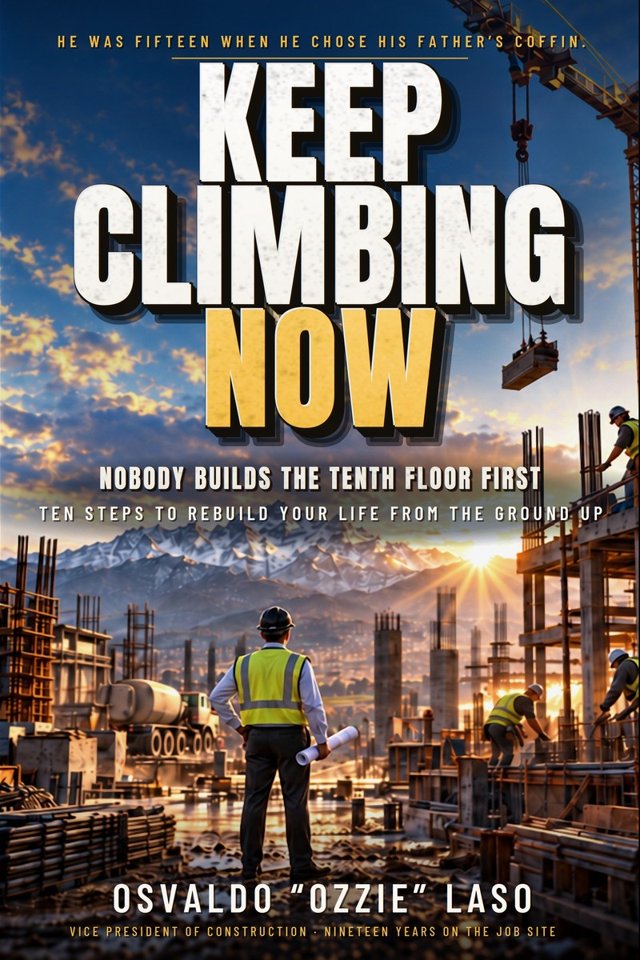
Keep Climbing Now: Nobody Builds the Tenth Floor First. Thirty-nine short chapters. Every one ends on the ground with something to do about it.